When problems arise on a packaging line, the machine is often looked at first. In practice, however, it regularly turns out that the cause lies in a mismatch between the film and the packaging machine.
A film that meets specifications on paper does not automatically perform well on every packaging line. If film properties are insufficiently compatible with the machine, this can lead to downtime, quality issues, lower output, and higher packaging costs.
What mistakes are most often made when choosing film for automatic packaging machines?
1. Just looking at the foil price
One of the most common mistakes is selecting foil based on price per kilogram or price per pack.
Although material costs are important, they only form part of the total packaging costs.
When a cheaper film leads to:
- More machine downtime
- Lower output
- More disapproval
- Extra maintenance
- More product loss
the total cost price could indeed be higher.
This is why it is important to look at the Total Cost of Ownership (TCO) of the packaging and not exclusively at the film price.
2. Insufficient attention to runability
Many packaging projects focus on packaging properties, while machine processability is only assessed later.
Properties such as:
- Coefficient of friction (COF)
- Stiffness
- Arson
- Slipperiness
- Poem tolerances
have a direct impact on the performance of the packaging line.
A film that technically meets all product specifications can still cause transportation problems, unstable processing, or frequent downtime.
3. Choosing foil without involving the machine supplier
The packaging machine and the film form one system. Yet, film choices are regularly made without consulting the machine manufacturer or without practical validation on the packaging line. This sometimes leads to problems that could have been easily prevented beforehand. Collaboration between the film producer, end-user and machine supplier often leads to a faster and better result.
4. Laboratory conditions testing only
Laboratory tests are valuable, but don't always provide a complete picture of practical application.
Factors such as:
- Product shape
- Product weight
- Ambient temperature
- Production speed
- Operator settings
have a major influence on the performance of a packaging film. A film that performs well in a laboratory may behave very differently on the production floor. Therefore, validation in practice is essential.
5. Too much focus on foil thickness
When it comes to packaging, the number of microns is still often seen as the most important quality indicator.
In reality, the performance of a film is determined by far more factors than just thickness.
Modern raw materials, multi-layer structures and optimised formulations make it possible to achieve the same or even better performance with less material.
The question should therefore not be: “How thick is the foil?”, but: “Does the foil perform optimally within this application?”
6. Insufficiently assessing barrier properties
Barrier properties are often crucial in food packaging and other sensitive applications. However, insufficient attention is sometimes given to this during selection.
Depending on the product, features such as:
- Damp-proof membrane
- Oxygen barrier
- Aroma retention
- Light barrier
have a direct impact on shelf life and product quality.
A film that runs excellently on the machine, but offers insufficient protection, ultimately solves nothing.
7. Future legislation not taken into account
New regulations, including the PPWR, are ensuring that packaging must increasingly meet requirements regarding recyclability, material use, and circular design.
A film that functions well today may no longer meet future market demands.
Therefore, it is advisable to directly consider future developments in sustainability and legislation for new packaging projects.
Frequently asked questions about film for automatic packaging machines
What causes the most downtime on automatic packaging lines?
Besides machine settings, film properties are one of the main causes of downtime. Problems with transport, sealing, cutting or film tension can often be traced back to a poorly suited film.
Is a thicker film always better for automatic packaging machines?
No. A thicker film doesn't automatically offer better performance. The right combination of material structure, formulation.
Why is practical validation so important?
Because laboratory conditions do not simulate all the factors of a real production line. Practical tests provide insight into runability, output, seal performance, and product quality under actual conditions. With a process at KIVO, a product specialist always accompanies a trial run to see how the film performs in practice.
Does the same film work on every packaging machine?
Not always. Different machines have different requirements for properties such as COF, stiffness, sealing behaviour, and film tension. Therefore, customisation is often necessary. This is also why KIVO works with unique formulations for different applications and processing methods.
How much experience does KIVO have with films for automatic packaging machines?
KIVO has been working with manufacturers in various sectors for decades to optimise packaging lines. In doing so, we support customers with material selection, thickness reduction, runability optimisation, and practical validation. A KIVO product specialist always accompanies you to test a film in practice.
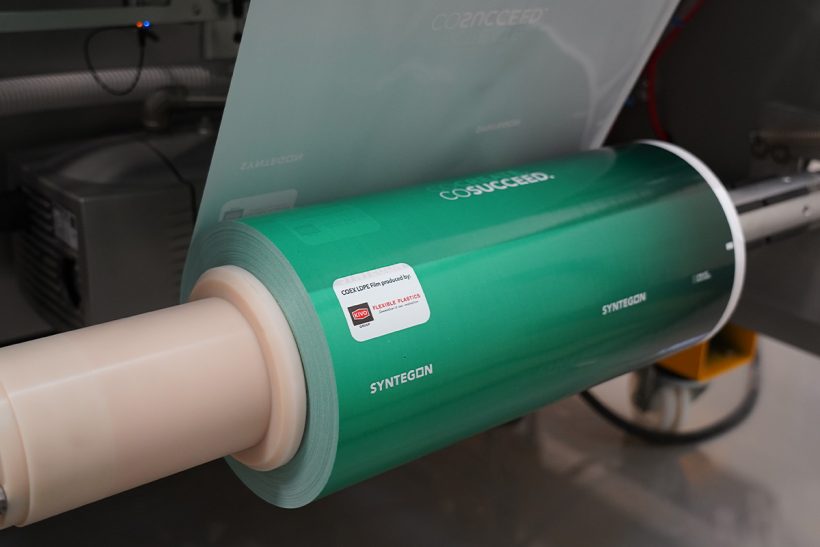
In addition, we work continuously with renowned machine manufacturers such as GEA, Syntegon, PATTYN and other machine builders. By approaching film and machine as a single system, we have already helped hundreds of customers to reduce downtime, increase output and lower packaging costs.
Conclusion
Choosing the right film for an automatic packaging machine is about more than just price, thickness, or product specifications.
Successful packaging processes arise when film properties, machine settings, and product requirements are optimally aligned. It is precisely this coherence that determines whether a packaging line runs stably, achieves high output, and prevents unplanned downtime.
With decades of experience and collaboration with both customers and machine manufacturers, KIVO helps companies make future-proof film choices that contribute to efficiency, sustainability, and lower total packaging costs.
Curious if your current film is performing optimally on the packaging line? Get in touch with one of our specialists for an analysis of your packaging application.