With the Plastic Tariff Differentiation Scheme 2026, Verpact encourages producers and importers to market plastic packaging that is demonstrably more recyclable. The scheme, which takes effect from 1 January 2026, replaces previous pricing models and is emphatically in line with Design for Recycling and future requirements from the PPWR.
The premise is clear: the better a packaging scores on recyclability and utilisation of post-consumer recyclate (PCR), the lower the waste management fee. Packaging that hinders the sorting and recycling process will continue to be taxed at the standard rate.
What does Rate Differentiation Plastic 2026 mean?
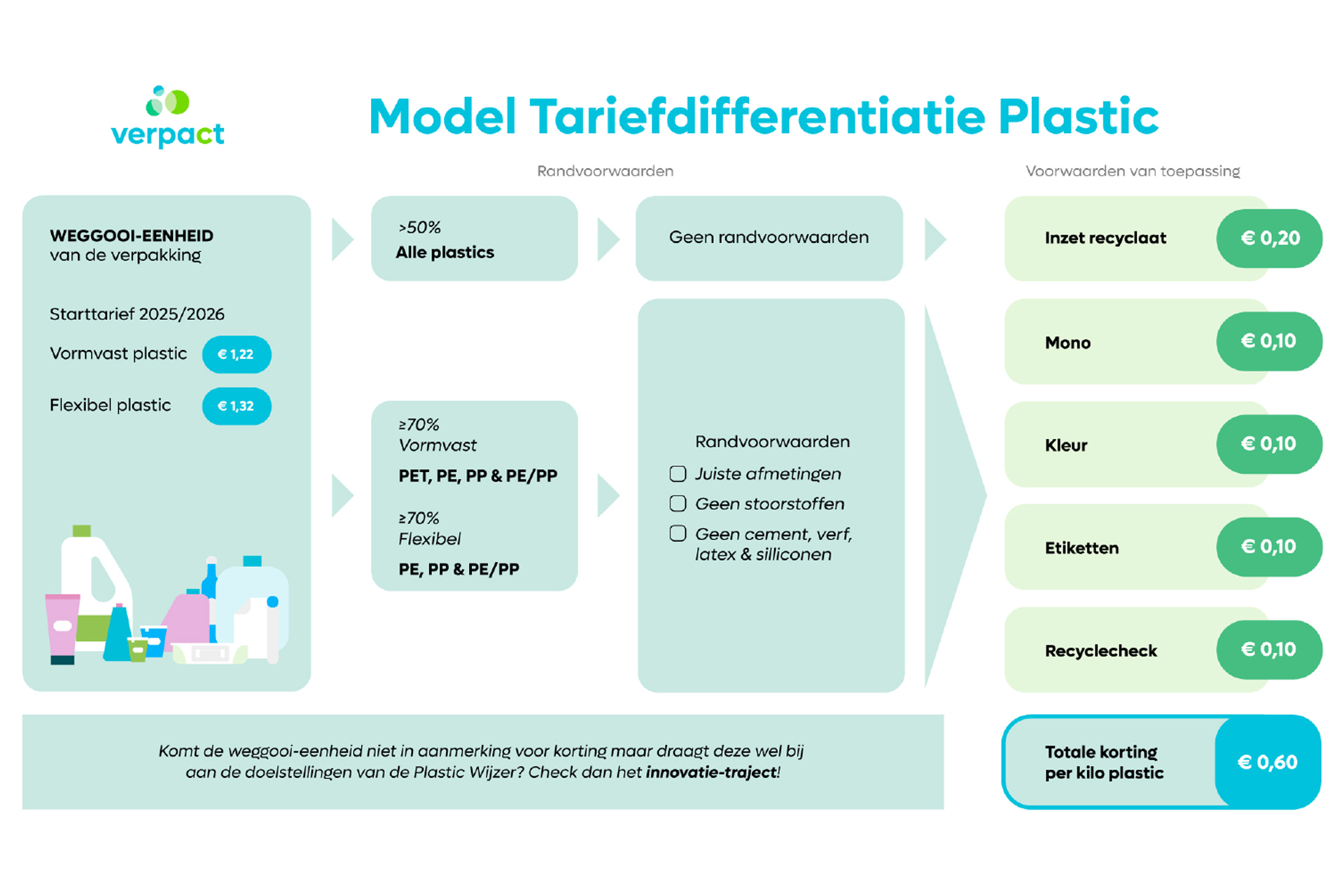
Tariff differentiation means that the plastic material tariff within the Packaging Waste Management Fee can be reduced if a packaging meets established sustainability criteria. The assessment takes place per discard unit and distinguishes between rigid and flexible plastic packaging, as they are collected and recycled differently.
The maximum rate discount in 2026 is €0.60 per kilo of plastic per unit of discard. This discount is made up of individual discount steps, which can be applied cumulatively when all preconditions are met .
Preconditions: when does packaging qualify in the first place?
A disposable unit is eligible for tariff discount only if the following basic conditions are met, among others:
- more than 50% of the weight is plastic;
- the packaging consists of at least 70% of a permitted target material:
- Shape-retaining: PET, PE, PP or PE/PP;
- Flexible: PE, PP or PE/PP;
- the packaging does not contain interfering substances such as PVC, PVdC, oxo-degradable materials, silicones or rubber-like substances;
- the packaging is correctly specified and fully substantiated towards Verpact.
If a package does not meet these preconditions, no tariff reduction is possible, regardless of other characteristics.
Which properties provide rate discounts?
Once the preconditions are met, the following discounting steps can be applied:
- Deployment of post-consumer recyclate (PCR) - €0.20/kg
- Contact-sensitive packaging: minimum 10% PCR
- Non-contact packaging: at least 20% PCRThe PCR percentage is calculated over the total plastic weight of the disposable unit, including closures and other plastic components.
- Mono-material - €0.10/kg
- Moulded packaging: at least 95% PET, PE or PP
- Flexible packaging: minimum 90% PE or PP
- Maximum 5% (form-fixed) or 10% (flexible) functional additives such as EVOH, tie-layers, coatings or inks, respectively. - Colour of target material - €0.10/kg
- PE and PP: natural/colourless or white
- PET: natural/colourless
- At least 90% of the target material must meet this colour requirement. - Labels, sleeves and printing - €0.10/kg
- Labels and sleeves are made of PE or PP and easily removable;
- Limited coverage: flexible: maximum 30% of the surface, dimensionally stable: maximum 50% (500 ml);
- No use of carbon black or metallised layers that interfere with grading. - KIDV Recyclecheck - €0.10/kg
The packaging achieves the final score ‘good recyclability’ in the current KIDV Recyclecheck for rigid or flexible packaging.
All discounts are cumulative, up to the maximum of €0.60 per kilo of plastic.
Why is this relevant in the light of PPWR?
The system of Rate Differentiation Plastic 2026 anticipates the PPWR requirements around:
- minimum recyclability;
- preference for mono-materials;
- limitation of colour, additives and interfering substances;
- demonstrable recyclability at scale.
By optimising packaging according to this scheme now, producers and importers not only reduce costs, but also future compliance risks towards 2030 and 2038.
The role of KIVO
KIVO supports customers in exploiting Rate Differentiation Plastic 2026 by analysing existing packaging structures and optimising them where possible. This includes:
- redesigning multilayer structures into recyclable mono-PE solutions;
- testing packaging against preconditions and discount steps;
- advising on colour use, labelling and printing;
Providing technical specifications, PCR statements and data sheets as substantiation towards Verpact.
This is how KIVO helps customers realise concrete tariff benefits while taking steps towards PPWR-proof packaging.

 info@kivo.nl
 +31 (0) 299 39 88 00